
“Usharak sat on a dune of sand. In the distance he could see the walled city of Quantium. The surrounding desert was a gorgeous, rosy hue, and the sky above was filled with colorful clouds carrying the magic-infested water of the Miasmere. He took in the sight with a tinge of guilt. It wasn’t an unusual feeling for him. He always carried this guilt, and it was always heaviest for Usharak when he experienced a moment of beauty and peace. He began repeating the names of those he carried with him like a prayer: ‘Telek, Nishkim, Bozi, Arakuru.’ The list seemed never-ending.”1
Ready to rise again?
First off, I’m coming in and tweaking things because I’m a subscriber so I got my PDF of Impossible Magic on Monday, so now I have the entirety of this amazing work at my fingertips. Even changed the opening quote! Suffice to say Usharak runs into an old friend of ours, a certain Magus… Anyway, I hope y’all are enjoying the pdf who got it, and I love seeing all the chatter around it on Discord, BSKY, youtube, reddit, etc. So let’s keep talking!
As a reminder, in Part 1 I dug into the final Necromancer from 1st through 4th level, including the new Fatal Methods, revised thralls, Grim Fascinations, and the wonderfully difficult choices awaiting us among those early class feats. Last time while taming the High Seas I snuck back into the crypt to explore some of the 6th through 10th level options by building both Reaper and Puppeteer pirate captains. It was a perfect excuse, I mean reason! There was a ship made of bone right there! What was I supposed to do, show restraint? Not this roleplayer.
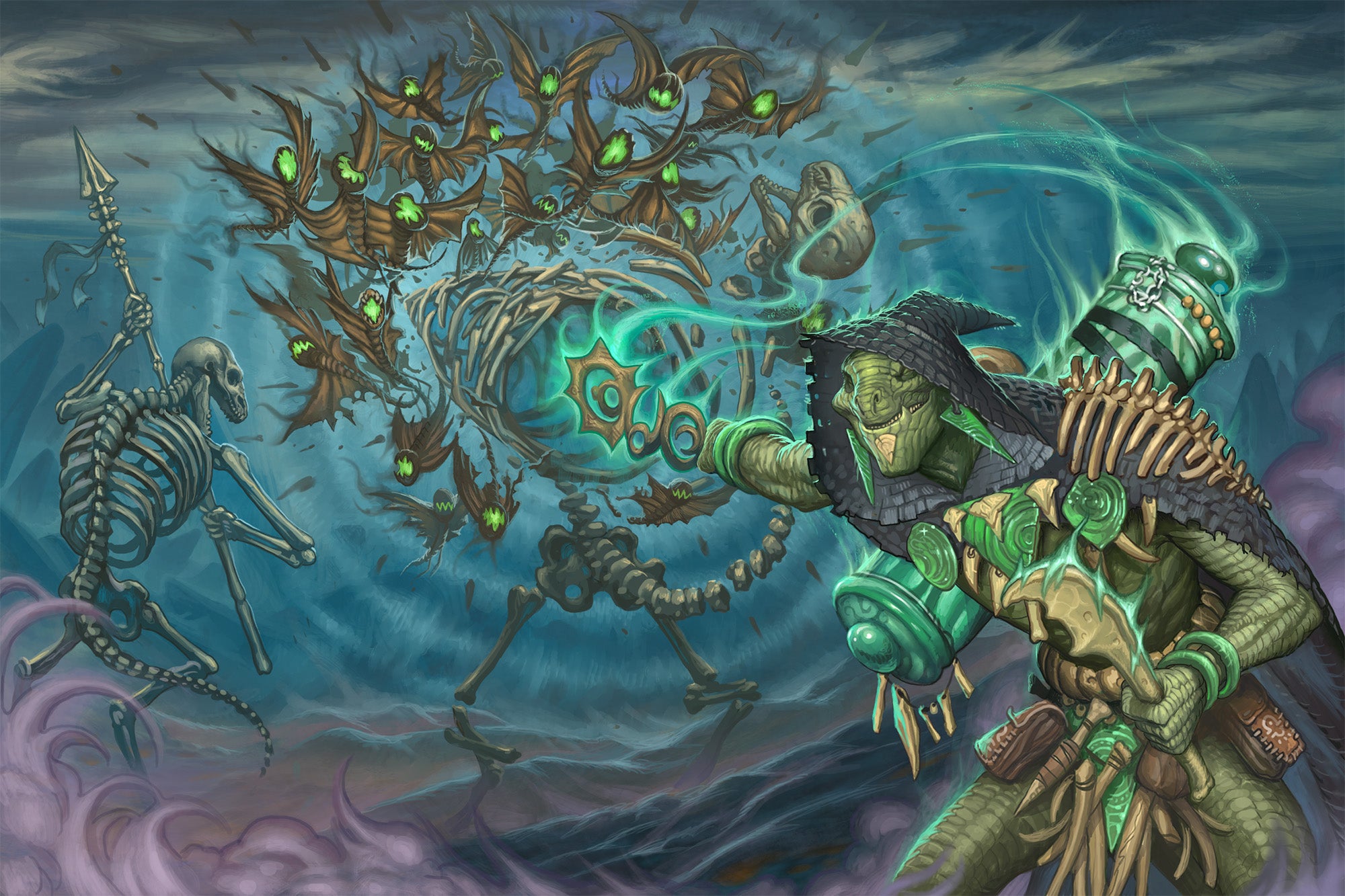
So that finally brings us to the high level Necromancer! We’re going from 11th level all the way through 20th, where your Necromancer stops merely bringing a graveyard to the battlefield and starts turning into one. Well, actually they can bring a graveyard too. Oh yes, that’s still available!
In general the distinction between the Fatal Methods becomes even clearer here. The Reaper continues developing into a surprisingly durable martial caster who uses thralls to create openings, fuel defenses, and support their own Strikes. The Puppeteer gains increasingly absurd ways to create, position, spend, and replace thralls while casting some of the strangest occult magic available. I’m interested to see where Magus and Necromancer combos start coming out, especially the comparison builds of which is best as full class and which is best as archetype. Outside of a few feats with explicit prerequisites, a Puppeteer can select something that looks martial, and a Reaper can absolutely concentrate on grave spells. Perhaps death does not like being put into neat little boxes.
Well, coffins are boxes, I suppose. Moving on!
Class Advancement
I’m going to start with the class advancement over these levels with a nice screenshot here:
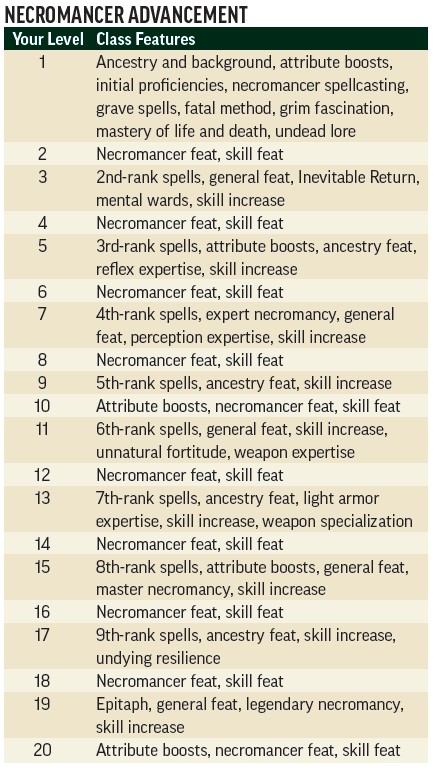
Levels 11 through 20 haven’t changed since the playtest. Undying Resistance (level 17) is a bit shorter description-wise, but only because now it’s not restating what you got with Unnatural Fortitude (level 11) and that’s that Fort successes are crit successes. Other than that, all the same. The real focus is on feats and focus powers so let’s shuffle over there!
12th Level: The Body Becomes the Thesis
At 12th level, we now have 7 feats to choose from.
Become as Spirit requires the Spirit Grim Fascination. You can pass through unwilling creatures’ spaces as difficult terrain, ignore natural difficult terrain, and gain a bonus to Escape attempts. Whenever you destroy a thrall, you also gain resistance equal to half your level against nearly all damage for 1 round, with force, ghost touch, spirit, and vitality among the exceptions.
I love this as it’s excellent for a Spirit Reaper. You can glide through enemies, get where your weapon needs to be, and gain broad resistance by destroying a thrall during your turn. It is still attractive for a Spirit Puppeteer (especially my own Necromancer Varatin) but the ability to move directly through the enemy line is practically begging for a weapon in hand. I love the haunting aspect I’ll be able to bring to it. The RP of these feats is always so much fun.
Bridge of Graves is brand new and grants the 6th rank grave spell of the same name. For two actions, you create a 10-foot-wide bridge of grave dirt and tombstones that can stretch as far as 120 feet, including up or down at an angle. It has its own Hardness and Hit Points, remains for 10 minutes, and improves in length, durability, and potential width as it heightens. The especially necromantic part is that a thrall standing on or adjacent to the bridge can move to any location along it whenever you command that thrall to Stride. Suddenly your slow-moving thralls have a rapid transit system made out of graves.
This is an obvious Puppeteer option. It can carry your undead pieces across chasms, up toward elevated enemies, along the deck of a ship, or straight through an inconvenient battlefield. Reapers can use it too, but a Puppeteer is more likely to have enough thralls scattered around to turn that bridge into a true undead highway and your enemies right to the Boneyard. Pharasma still likely isn’t happy with you, though.
Endless Return is also new. It improves Inevitable Return by giving you an additional reaction at the start of each turn that can be used only for Inevitable Return. When multiple Small or Medium enemies are dying within 30 feet, you no longer have to choose which death deserves to become a thrall.
Puppeteers want bodies, and this creates more bodies without using actions. That is about as straightforward a recommendation as I can make. A Reaper standing near the front line may also see more eligible deaths and appreciate the extra flanking partners, but this feat belongs near the top of the Puppeteer list.
Grave Focus (was Necrotic Focus) completely refills your Focus Pool whenever you Refocus. Remember that any Necromancer can already destroy a thrall while Refocusing to regain 2 Focus Points instead of 1, so this feat is not as mandatory as it might first appear unless your characters are constantly feeling pressed for time between combat. A Puppeteer built around repeatedly casting grave spells will probably get the most from it. A grave-spell-heavy Reaper can still love it, especially if they are regularly opening encounters with bind heroic spirit.
Reinforced Skeleton requires the Bone Grim Fascination. You gain resistance equal to half your level against one chosen energy damage type and either slashing or piercing damage as it was in the playtest. You also gain a +5’ status bonus to your Speeds that temporarily increases whenever you destroy a thrall to +10’, so a little weaker than the playtest version. I guess playtesters found the Necromancer too mobile with this one.
The Bone Reaper is an obvious match. Resistance, mobility, and martial proficiency all reinforce the character who intends to charge into danger behind a screen of scuttling skeletons. A Puppeteer still benefits from passive resistance and Speed, but this really helps a Reaper survive where they have chosen to stand.
Sanguine Mastery is brand new because it requires the Blood Grim Fascination. You gain bleed resistance equal to half your level, and if an enemy within 30 feet is bleeding, you gain fast healing equal to half your level. Destroying a thrall also lets you inflict or increase persistent bleed damage on a creature adjacent to that thrall by 1 point, limited to once a round. Makes me almost want the Blood Necromancer.
This one has a lovely tension between the two Fatal Methods. A Puppeteer produces and destroys more thralls, creating more opportunities to increase bleed damage. A Reaper is more likely to stay within 30 feet of bleeding enemies and benefit from the fast healing while fighting them directly. Basically, Blood continues to be excellent with either Fatal Method. Shocking, I know. Blood gets everywhere!
Thick Skin (was Vital Conduit) requires the Flesh Grim Fascination. It’s much the same, but toned down. It increases your maximum Hit Points by your level, essentially giving you the Toughness feat’s HP benefit again still. Now only the first time each round you destroy a thrall, every enemy adjacent to you must attempt a Fortitude save or become sickened 1.
It’s still extremely Reaper friendly. More Hit Points are always welcome, and the sickened effect specifically rewards you for being surrounded by enemies while sacrificing thralls. Since a Puppeteer generally wants more distance between their delicate body and anything capable of stabbing it, I don’t see it getting chosen often. A Flesh Reaper can still wade into the middle of a fight and make everyone regret standing nearby.
At 12th level, my strongest general recommendations are Endless Return or Bridge of Graves for Puppeteers, while Reapers should look carefully at the defensive Grim Fascination feats. Become As Spirit will really tempt me but so will that Bridge.
14th Level: Some Assembly Required
At 14th level, we also get 7 feats instead of the two from the playtest, Recurring Nightmare and Skeletal Lancers, which are still options.
Amalgamate is new. It’s a single action that destroys two adjacent thralls within 30 feet and fuses them into one Large thrall. The resulting amalgamation has a Speed of 25 feet, 10-foot reach, and a status bonus to its Strike damage equal to your level. That is a +14 damage bonus when you first select the feat, eventually increasing to +20. Worth noting by level 14, your thralls do 4d6 damage (1d6+1d6/4 levels). So is it better to have two thrall Strikes (lower AC creatures maybe) or one big Strike (plus with the reach)?
The amalgamation is still fundamentally a thrall, so it is not an indestructible undead companion. It is a large, frightening, highly expendable weapon. Puppeteers have the clearest advantage because they can produce the two required thralls more easily. Reapers, however, can use its reach to provide flanking, threaten a wider area, and support their own battlefield positioning.
Blood Pool is a reaction available when a creature with blood within 30 feet dies or takes bleed damage. You create a pool of healing blood in a space beside that creature. The pool lasts for 1 minute, and an ally who enters its space can absorb it as a free action to regain Hit Points equal to your level. Combine this with the extra reaction Endless Return and you can be creating thralls and making blood pools both!
Blood Necromancers already want enemies bleeding, so triggering this should not be difficult. A Puppeteer can spread bleed effects through thrall destruction and create healing points around the battlefield. A Reaper can use them to help sustain fellow frontliners while continuing to pressure the bleeding enemy. It is wonderfully gross support magic. Your allies may complain about having to step into a puddle of enemy blood, but they will probably stop complaining after recovering 14 Hit Points for free.
Instinctual Creation is a free action triggered when you roll initiative. You immediately create two thralls in spaces adjacent to you. While I’m sure many like me will try to keep some around them, sometimes you don’t want to have thralls floating around or you’ll be surprised.
All necromancers will find this feat excellent. Puppeteers begin with resources ready for sacrifice, movement, or grave spells. Reapers begin with potential Body Shields, flankers, or nearby thralls that can be moved into position. Note it does not trigger Thrall Teamwork because you did not cast Create Thrall, but starting every fight with two bodies already on the board is still enormously useful.
Ocular Flesh (1-action) lets you create a marble-sized fleshy eyeball. You can take an action going forward to look through one of your created eyes, and the eyes can be rolled, thrown, or attached to a surface. They last for 24 hours, though you can maintain only three at once and they are easy to discover and destroy.
Ocular Flesh is very useful for the remote-observation need, and any Necromancer can use these as surveillance cameras, dungeon scouts, security measures, or deeply unpleasant gifts. Considering it’s you looking through your “eyeball” I assume you’ll want to have various sight-based abilities active while looking through.
Recurring Nightmare is back and still grants a 7th rank, one-action grave spell that creates a ghostly thrall but now within 60’ instead of 30’. The nightmare can share spaces with other creatures and flies at a Speed of 60’. When it is summoned into or moves into a creature’s space, that creature must save or become frightened 1 (or 2 on a critical fail). However, we also get some updates since the nature of thralls and their movement have changed.
It can later Strike so it’s specified that its Strikes deal void damage and gain additional 2d6 damage when commanded through Thrall Charge. It’s one beefed up (or spectral up?) thrall! Best of all, if the nightmare is destroyed, you can Sustain the spell to summon it again, once per round. Your Command Thrall still allows it to move, though at 60’ and flying!
I doubt this will surprise anyone but this is one of my favorite Puppeteer options in the entire class. It is mobile, disruptive, capable of attacking, and difficult to permanently remove while the spell continues. A Spirit Necromancer (like mine!0 can turn it into an especially coherent part of their character’s visual identity. Reapers can still use it as a mobile source of pressure, though its ability to occupy an enemy’s space does not automatically make that enemy adjacent to it for Thrall Teamwork.
Skeletal Lancers still grants a one-action, 7th rank grave spell, that creates as many as five spear-wielding thralls in different spaces within 60 feet. An enemy still takes 5 piercing damage when within 10’ of a lancer, max of once per Strike. Again because the nature of thralls has changed we get some clarified detail. The skeletal lancers have 30’ Speeds and 10’ reach. No longer would you sustain this spell, you’d use your Command a Thrall and get to move any number of them instead of just one when commanded to Stride.
Ooo, what spectacular battlefield control. Place the lancers around martial enemies and those enemies must either move, destroy the lancers, or take damage every time they attack. A Puppeteer gets a ready-made formation of five thralls for one action. A Reaper gets reach, flanking partners, and a formation that punishes enemies for fighting back. Honestly, this might be one of the strongest options for either Fatal Method.
Unholy Resurrection requires that you not be holy. You’re shocked, I’m sure. You add raise dead to your dirge and cast it as an occult spell, but anyone returned by your version gains the undead trait. Only tremendously powerful magic can restore them to true life afterward. You also gain an additional spell slot at your highest Necromancer spell rank that can prepare only raise dead.
If you choose Unholy Resurrection, you’re really saying something about your character and campaign. Hopefully your fellow PCs wouldn’t be too angry about it. It’s powerful, unsettling, and likely to produce more roleplaying consequences than any numerical bonus in this section.
At 14th level, Puppeteers should look hard at Amalgamate, Recurring Nightmare, and Skeletal Lancers. Reapers will also get tremendous use out of the lancers, while Instinctual Creation is the universally practical choice. Unholy Resurrection is for the Necromancer who looks at the boundary between life and death and decides that boundary needs fewer regulations.
16th Level: Everybody Out of Their Bodies
We get six 16th level feats instead of three, including one we heard about from Josh Birdsong during our PaizoCon panel.
Anatomical Quartering is that one, brand new but teased by Josh! It’s a three-action activity in which you divide yourself into four overlapping forms: blood, bone, flesh, and spirit. You then make as many as four Strikes, each against a different target, without increasing your multiple attack penalty until all the attacks are complete. The final Strike converts its physical damage into spirit damage.
I’d say this is certainly a Reaper feat. It has no Reaper prerequisite, but making four weapon Strikes is not why most Puppeteers studied necromancy. The requirement to target different creatures means it is designed for clearing or pressuring a group rather than concentrating on one boss, but the delayed multiple attack penalty gives all four attacks a much better chance to connect. Also, momentarily splitting into four different anatomical interpretations of yourself before attacking everyone nearby is the kind of high level visual roleplay moment I want to see!
Beckoning Dirge requires the Puppeteer Fatal Method and can be used once per day as a free action. Your dirge flows into a thrall within 60 feet, allowing you to cast one spell from your dirge during that turn without preparing it or spending a spell slot. The spell can be as high as 1 rank below your highest Necromancer spell rank. The thrall becomes the spell’s point of origin and is destroyed afterward.
Beckoning Dirge is rather outstanding. It is emergency access to nearly any spell you have learned, even if you did not expect to need it that morning. It also provides Reach of the Dead-style positioning as part of the effect. At 16th level, you can pull out any spell in your dirge of 7th rank or lower. As your highest rank slots increase, Beckoning Dirge grows with you. That is pure Puppeteer power for flexibility and remote casting. I do enjoy how the thrall dramatically collapses after becoming the mouthpiece for forbidden magic.
Desperate Revival is back, a once-per-day reaction when you would be reduced to 0 Hit Points without being killed outright. You remain at 1 Hit Point and release a 60-foot emanation that deals void damage based on each target’s level, with a Fortitude save. They did change it however. Now instead of regaining half the total damage dealt, you recover Hit Points equal to the total damage dealt up to half your maximum HP.
The Reaper is more likely to need this, but no Necromancer is going to object to an emergency refusal to fall unconscious. Mastery of Life and Death gives you important control over whether your damage is void or vitality for each target, though remember that you are still dealing damage rather than healing your allies. The visual is fantastic too. The Necromancer is struck down, refuses to fall, and pulls enough life from everyone nearby to stand back up. Reminds me of some Black Robed magic from Dragonlance actually!
Effortless Concentration is also back and gives you a free Sustain action at the beginning of each turn for one active Necromancer spell. Puppeteers have more obvious uses for this because they are likely maintaining battlefield-control spells and special thralls. Recurring nightmare can be returned after its destruction without consuming one of your normal actions. Zombie Horde can keep expanding and moving. Any sustained spell becomes much easier to fit beside Create Thrall, Thrall Charge, or say Summon Undead. Reapers can benefit when their particular spell selection requires sustaining, but this is generally one of the premium caster-focused options.
Flesh Tsunami was also in the playtest. It still grants an 8th rank, two-action grave spell. You destroy a thrall to create greater difficult terrain in a 60-foot cone for 1 minute. However, the benefit of destroying a second thrall has changed. Now when you destroy a second thrall in the cone, those limbs grasp at every enemy (note enemy) in the area. They must make a Fortitude save or become immobilized for 1 round or until it Escapes. Originally it was only immobilized on a Crit Fail with 10’ or 20’ status penalties to speed based on pass or failure.
Certainly a tremendous option due to the 60-foot cone, well in line for 8th rank. A Puppeteer can originate it from a carefully placed thrall and has an easier time supplying the optional second sacrifice. The Reaper can use it to lock enemies away from allies or prevent them from escaping melee, but this primarily feels like the Puppeteer deciding which portion of the map is no longer convenient to walk through.
Temporary Possession is the last of the new 16th level feats. It grants a one-action, 8th rank grave spell. Note that although the feat limits its use to once per day is not actually accurate. I’ve checked with Josh and this is a leftover artifact of when it wasn’t going to be a focus power. You can use it normally as focus power. You destroy a thrall and attempt to possess a living or undead creature within 15 feet of it. Even on a successful save, you control the target long enough to make it Drop Prone, Interact, Release something, or Strike. A failed save lets you spend two actions through it, and a critical failure allows three. Afterward, the creature becomes stunned 1. There is a cost. If the target loses Hit Points while possessed or stunned by this spell, you lose Hit Points equal to half that amount because part of your spirit remains inside it. Its Strikes also use and increase your multiple attack penalty.
This is a Puppeteer option both mechanically and philosophically. You use a thrall, puppeting it into place and then destroy it to get another thrall, turning an enemy into your puppet. The incapacitation trait prevents it from completely dominating higher level opponents, but even the success effect can force a useful action and apply stunned 1.
At 16th level, Reapers get their clearest prize in Anatomical Quartering or Flesh Tsunami. Puppeteers face a much harder decision among Beckoning Dirge, Effortless Concentration, and Temporary Possession not that they can’t take Flesh Tsunami. That is a very good problem for a class to have and will certainly vary by your build. I’ll be quite tempted by Effortless Concentration and Temporary Possession!
18th Level: A Terrible Time to Have a Body
Five feat options instead of two is far better. 18th level is a long ways off for my Necromancer but doesn’t mean I can’t dream and plan now. And remember, Bind Heroic Spirit used to be 18th level, so that’s four new feat options!
Calcification grants a two-action grave spell that destroys a thrall and sends its powdered bone into a living or undead creature within 60 feet of the thrall. Be careful what you breathe in! On a success, the target is briefly slowed and gains weakness to bludgeoning. A failed save imposes slowed 1 and a larger bludgeoning weakness, followed by additional Fortitude saves at the end of its turns. Continued failures increase the slowed condition. If the creature eventually becomes completely unable to act because of that slowing, it is permanently petrified into bone. Creatures already made entirely from bone are immune, and the ongoing saving throws have the incapacitation trait. It can also strip the incorporeal trait and associated resistances from an incorporeal creature while that creature remains slowed.
Puppeteers are best at placing the sacrificial thrall near a distant target. Reapers, especially those wielding bludgeoning weapons, are best at exploiting the weakness after the spell lands. I particularly like this on a Bone Reaper: turn the enemy partially into bone, then explain the structural disadvantages with a hammer.
Dread Mosquito Storm grants a three-action grave spell with a 120-foot range and a staggering 60-foot burst. The storm is made of undead mosquitoes so if pushing bone dust wasn’t terrifying enough, this sure is. Three actions is a commitment, but you’re not casting this because you have a minor mosquito concern. You are turning an entire region of the encounter into one of disease, blood, and the dead. Love the roleplaying and evocative imagery; this is probably one of those things Josh noted he has no trouble writing.
Anyway, the storm remains for 1 minute, exposing creatures within it to necrotic blood, a disease that deals escalating void damage, applies sickened, and creates increasingly severe weakness to bleed damage. If an afflicted creature dies, it becomes another thrall. Complicated huh? Well here’s what that looks like:
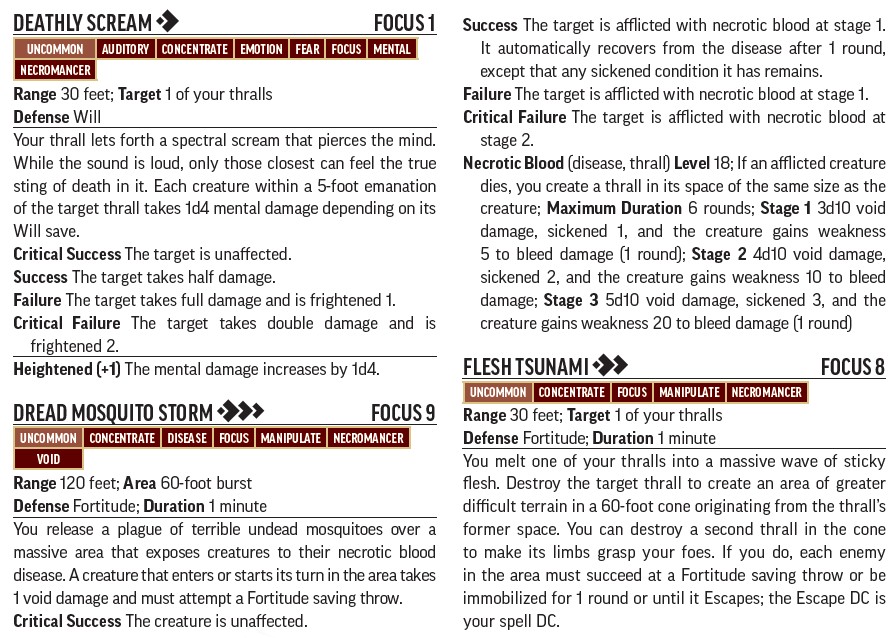
Oh yes, there’s Deathly Scream and Flesh Tsunami too! You’re welcome! I consider this a Puppeteer spell by scale alone. It covers a huge part of the battlefield, weakens enemies for Blood effects, and turns casualties into additional resources. A Blood Necromancer is going to have a particularly gruesome time combining the bleed weakness with their existing powers.
Ectoplasmic Aura is back from the playtest, but with clarification. At least I don’t think anyone thought it really was meant to be around all the time so maybe you might say this got weaker. The original playtest feat sort of read like it was always active. Now it’s a one-action ability lasting 10 minutes, though you can dismiss the aura or trigger it again. You and allies within a 30-foot emanation gain a +1 circumstance bonus to AC. An enemy that ends its turn in the aura must attempt a Fortitude save, losing its reactions until the beginning of its next turn on a failure.
I find this is still one of the best Reaper choices. You are already positioned close to allies and enemies, making it easy to share the AC bonus and suppress reactions. Ten minutes means it can potentially cover several encounters if your group is moving quickly. It’s still universally strong too in my opinion as a Puppeteer standing near the middle of a formation can protect a large portion of the party. The Reaper simply gets the most out of carrying the aura directly into the enemy line.
Power Hungry requires Reclaim Power from level 6. That’s the feat that lets you destroy up to three thralls and regain hit points equal to your level per thrall destroyed as well as reduce clumsy, enfeebled, frightened, sickened, or stupefied by 1. Now when you destroy three thralls with Reclaim Power, you completely refill your Focus Pool in addition to its normal benefits. At 18th level, that means one action can destroy three thralls, restore 54 Hit Points, reduce one of several troublesome conditions, and refill as many as 3 Focus Points. It remains limited to once every 10 minutes, but that is an astonishing in-combat reset.
This heavily favors Puppeteers because they are best at ensuring three expendable thralls are available when needed. I’m quite tempted by it. Reapers can build toward it too, but the Puppeteer’s additional thrall production makes the cost far easier to meet.
Reanimate Foe is a serious three-action grave spell that launches one of your thralls into the corpse of an enemy that died within the last minute. It must have either been a living or undead creature, dead for no more than 1 minute. You attempt an Undead Lore check against the standard DC for the dead creature’s level. On a success, the enemy returns as a minion under your control. It retains its attack modifier, defenses, Perception, skills, and ordinary Strike damage, but loses its special abilities and most unusual traits. It has 100 HP and loses 15 HP after taking its actions each turn.
Even a failed check still reanimates a weaker version that deals half Strike damage and decays much faster at 50 HP each turn, though you could heal it with void! On a critical failure, you create only an ordinary thrall but you don’t lose the Focus Point at least. I appreciate that failure structure. The spell might produce a powerful temporary servant, a rapidly collapsing distraction, or merely refund your resource and leave a normal thrall behind.
This is peak Puppeteer. The enemy brought a powerful martial creature to the fight, your group killed it, and now you would like to borrow it for the remainder of the encounter. Legendary Undead Lore makes you especially well equipped to succeed at the check.
Man, it’s getting harder and harder to talk recommendations. I guess at 18th level, Ectoplasmic Aura is my strongest Reaper recommendation, with Calcification offering a wonderfully vicious weapon combination. Puppeteers must choose between the immense area control of Dread Mosquito Storm, the resource engine of Power Hungry, and the glorious audacity of Reanimate Foe.
20th Level: The Grave Is Not the End
And then there was 20th level, the pinnacle, and it’s six options for your feat. The three from the playtest are still here. I like to think several of them are less “feat” and more “campaign-ending declaration.”
Final Union is that high level follow up to Bind Heroic Spirit, requiring it and effectively making it a Reaper capstone. You become permanently affected by a 10th rank bind heroic spirit, representing an eternal pact between yourself and the heroic soul. That means a constant +2 status bonus to attack rolls and saving throws, while your critical weapon hits continue calling new thralls into the fight. You also gain Additional Lore based on the spirit’s knowledge.
It gets stranger from there. If you would fall unconscious, the spirit takes control and allows your body to continue acting. If you die, it can puppet your corpse for as long as 1 minute. During that time, your body becomes an undead object with extensive immunities. You have 200 HP as this object and a Broken Threshold of 100, which would make you slowed 1 if broken. If the body is destroyed, it must be repaired through extremely difficult Crafting or powerful magic before you can be restored.
Now here’s the payoff I referred to previously! The Reaper no longer merely carries a heroic spirit into combat. The two of you have become inseparable, perhaps even forming an entirely new identity. So excited to see or hear of someone using this. I’m playing a Reaper so it won’t be me, well unless an enemy in my Kingmaker game…
Instant Army is a one-action ability usable once per day. You immediately create as many as 20 thralls in spaces within 120 feet. I guess I’d say this is the Puppeteer capstone distilled into a single sentence though no requirement necessary. Twenty thralls can fuel grave spells, fill paths with difficult terrain, create flanking positions, provide targets for Reach of the Dead, feed Reclaim Power, or simply make the GM reconsider whether the map was drawn large enough.
Reapers can certainly use the sudden resources, but Puppeteers are the characters who have spent 20 levels learning how to turn a field of expendable undead into a complete battle plan!
Living Graveyard is still available and grants a one-action, 10th rank grave spell but it’s stronger and with changes due to Thrall changes. You create a Gargantuan thrall made from graves, tombstones, and the dead buried within them. Range is now 120’ instead of 100’ which is nice. When it appears, creatures within 10 feet must save or fall prone, and five ordinary thralls spill out around it. The living graveyard has 400 Hit Points, a Speed of 60 feet, and 15-foot reach. Every time it Strides, it creates five (not three) more thralls along its path. When commanded to Strike through Thrall Charge, it deals an additional 3d6 damage. I mean look at this:
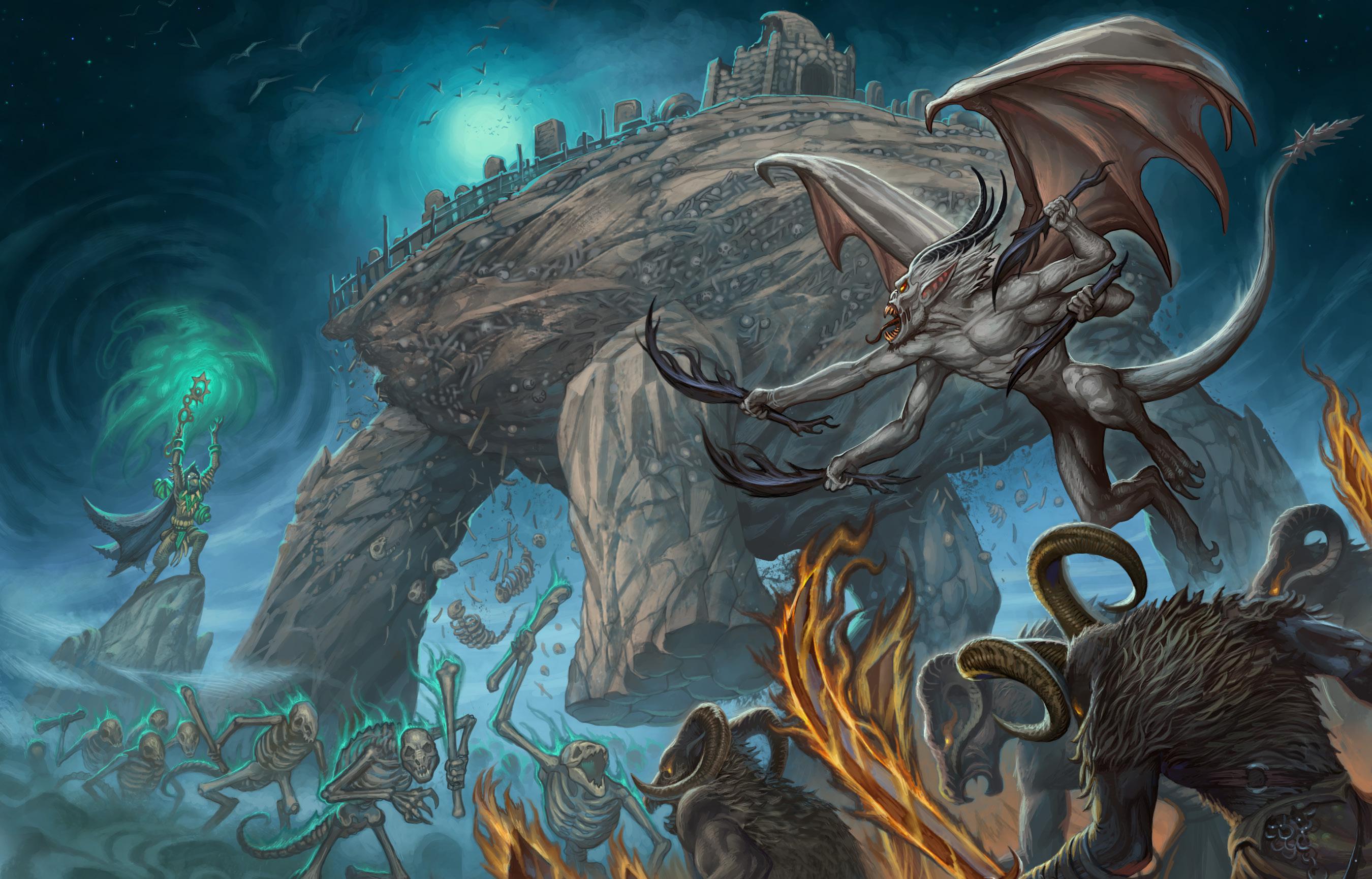
Okay maybe this is a Puppeteer capstone! They’re no longer bringing an army to the fight. The Puppeteer is bringing the place where the army was buried. Position the initial appearance carefully because the eruption can knock allies prone too. Once it begins moving, however, the graveyard continuously populates the battlefield with new resources. A Reaper can fight beside it as an enormous mobile flanking and thrall-production engine, but this is the grand Puppeteer fantasy made into a focus spell.
Mortem Ultimatum requires Epitaph (19th level class feature) and grants a second 10th rank spell slot. Like other high level spellcasters you simply gain another use of the most powerful conventional occult magic in the game each day.
I’d say don’t discount it because a second 10th rank spell can change an entire adventuring day. Puppeteers may be more naturally spell-focused, but any Necromancer who values their prepared casting should consider this carefully before selecting one of the more theatrical capstones. I’ll hit on some of the new 10th level Occult spells in my Impossible Magic hype article next time, on the 30th!
Perfected Thrall returns, still a one-action, 10th rank grave spell. And again, it’s got some changes due to Thrall changes. You create a thrall representing the union of every Grim Fascination: dense muscle, hardened bone, a heroic spirit, and a weapon formed from blood. The perfected thrall has 200 Hit Points and a Speed of 40 feet. Whenever one of your abilities would destroy it, the thrall loses only 20 Hit Points instead. Ordering it to Strike with Thrall Charge adds 6d6 damage! But also its critical hits can create as many as four ordinary thralls next to the target or the perfected thrall!
It’s certainly a smaller and more concentrated alternative to the Living Graveyard. The graveyard floods the field with bodies. The perfected thrall is a durable elite servant that can repeatedly fuel abilities without immediately disappearing. Puppeteers will naturally love having such a powerful command piece. Reapers can also fight beside it, use the new thralls created by its critical hits, and benefit from having a far more durable partner than the usual 1-HP servant.
Soul Thief is sadly our last feat to discuss. It requires you to be unholy and can be used once per day on the soul of a recently deceased creature of at least 18th level. On a successful Occultism check, you imprison that soul inside a gem, preventing the creature from returning to life while the gem remains intact. You can maintain three such gems. You can also consume one! Doing so makes you unholy and undead, grants void healing, extends your existence by 50 years, protects you from several forms of immediate death, and allows you to rebuild your body at one of your remaining soul gems if destroyed.
This feat really doesn’t come down to a Reaper or Puppeteer choice. You choose Soul Thief if you’re the kind of Necromancer who has completed their transformation into an immortal villain entire campaigns are written about. Or hero, I suppose. A deeply alarming hero.
At 20th level, Final Union is the natural conclusion for a Reaper who has carried Bind Heroic Spirit through the campaign. Instant Army, Living Graveyard, and Perfected Thrall each offer a different Puppeteer fantasy: overwhelming quantity, a mobile thrall factory, or one nearly indestructible masterpiece. Mortem Ultimatum is the quietly devastating spellcaster option, while Soul Thief is for characters whose retirement plan requires several imprisoned souls and a very understanding party. Hopefully they fetched your treasure for you!
Pulling the Strings or Swinging the Scythe
Looking across all 20 levels, I really appreciate that Reaper and Puppeteer do not feel like minor variations on the same Necromancer.
The Reaper begins with martial weapons, medium armor, and Thrall Teamwork, then grows into a character with expert martial attacks, expert medium armor, weapon specialization, tremendous Fortitude defenses, and powerful options such as Bind Heroic Spirit, Anatomical Quartering, Ectoplasmic Aura, and Final Union. The Reaper is still very much a spellcaster, but the class gives you a real reason to stand in melee instead of merely doing so because the enemy reached you.
The Puppeteer continues developing the Necromancer’s unique battlefield game. Extra thralls become free reactions, opening resources, enormous formations, reanimated enemies, and eventually entire armies. Beckoning Dirge creates incredible spell flexibility. Grave Focus and Power Hungry keep the grave spells flowing. Living Graveyard makes your thrall engine nearly literal.
Most importantly, the two Fatal Methods still share the Necromancer’s central identity. Both create the dead, command the dead, destroy the dead, and turn that destruction into their next advantage. They simply disagree about whether the Necromancer should be standing behind the army or swinging a weapon from the middle of it.
For Varatin, my Spirit Puppeteer, I am doing a lot of consideration. I’m tempted by Become as Spirit, Endless Return, Recurring Nightmare, Beckoning Dirge, Effortless Concentration, and Reanimate Foe. Living Graveyard might be difficult to resist at 20th level, though Instant Army would certainly make his spectral court feel properly populated. There are a lot of levels before I need to make those decisions. I’m sure I’ll be completely decisive and not reconsider the entire build every time I reread a feat.
Next Time
So that completes our journey through the Necromancer class from its first fragile thrall to its final walking graveyard! On July 30th, Investing In returns with a full review of Impossible Magic. We’ll be looking beyond the Necromancer to the Magus, Runesmith, Summoner, archetypes, spells, items, connections to the Impossible Lands, and everything else waiting inside the book! I’ll have to consider the spells (especially impossible spells) for our necromancers! Like the second rank Draw Blood that grows a mouth on your hand! I’ve spent a lot of time hyping the Necromancer (and clearly I am not finished) but Impossible Magic has much more magic to invest in!
Also, a bit sooner, next week on July 21st, you can find Ryan and I live on KnowDirection to talk with Josh Birdsong on all things Impossible Magic! We’ll be able to dig heavily into all those things he had to hold back on and by then I’ll have read through the entirety of this PDF, let alone everyone else doing so and keeping the convos going online. Got some specific questions for him? Let me know on bsky! Going forward I might ready some reddit threads for KD convos.
Alrighty folks until next time, please remember to support one another and, of course, much love to all!
Investing In:
I wasn’t quite sure what to name my article series when I first started but the idea of showcasing or discussing things that make me excited, that I find new and interesting, or maybe I’m otherwise passionate about seemed to fit with the idea of Investing In something like the Pathfinder 2E mechanic. To use some magic items you have to give that little bit of yourself, which helps make these things even better. I like the metaphor of the community growing and being strengthened in the same way!
I also want to hear what you’re Investing In! Leave me a comment below about what games, modules, systems, products, people, live streams, etc you enjoy! You can also hit me up on social media as silentinfinity. I want to hear what excites you and what you’re passionate about. There’s so much wonderful content, people, groups (I could go on) in this community of ours that the more we invest in and share, the better it becomes!
Sources
Banner – Necromancer opening banner art, Impossible Magic, Paizo
- The Search for Nex, Part 2 excerpt, Impossible Magic, Paizo
- Bony Barrage, Impossible Magic, Paizo, art by Firat Solhan
- Necromancer class table, Impossible Magic, Paizo
- Dread Mosquito Swarm, Impossible Magic, Paizo
- Living Graveyard, Impossible Magic, Paizo